


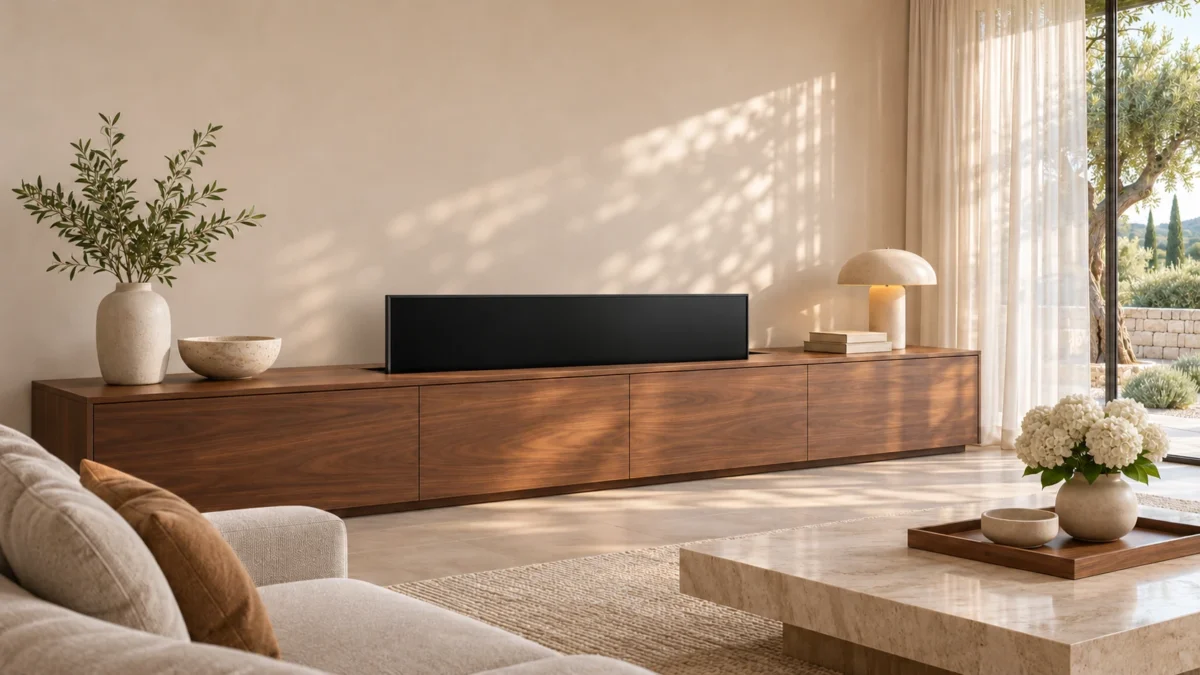
A hidden television sounds like a finishing touch — something chosen with the cushions. In practice it is a piece of engineering built into the joinery or the ceiling, and almost every decision that makes it work has to be made before the carpenter or the ceiling contractor starts. If the TV is going to disappear, the room has to be designed around the moment it appears.
Four ways a TV disappears
Most concealed screens use one of a handful of movements. A cabinet lift raises the TV out of a low unit at the foot of a bed or in front of a window. A ceiling drop lowers it from a void above, which suits rooms with no wall to spare. A moving panel or artwork slides or lifts away to reveal a screen behind it. And an articulated or swivel bracket turns a screen to face a different seat, or folds it flat when it isn’t needed.
Manufacturers such as Future Automation make TV mechanisms for cabinets, ceilings and moving panels, alongside projector and speaker mechanisms. The right one is decided by the room: where people sit, what is above and below the screen position, and what the space has to look like with the TV away.
Pick the screen before the joinery is drawn
The mechanism is sized around a specific TV’s width, height, depth and weight, so the screen needs to be chosen first. Future Automation says its standard products are VESA mount compatible, with custom mounts for some screens, which covers most televisions — but the cabinet or ceiling void still has to be drawn for the actual model.
That creates a real tradeoff in a fast-moving TV market. If you change your mind about screen size after the joinery is built, the opening, the lift travel and sometimes the whole cabinet are wrong. Agree the screen, allow for its replacement in a few years, and only then let the cabinetmaker work to the mechanism drawings.
Space, structure and travel
A cabinet lift needs depth and height inside the unit for the screen and the lift itself, plus a lid that opens cleanly. A ceiling drop needs a void deep enough to hold the screen flat or vertical, and a structure strong enough to carry the mechanism and screen. In Dubai villas and apartments the ceiling void is often already crowded with ducted AC, sprinkler pipes and lighting, so checking that space early with the MEP drawings saves a redesign later.
Panels and artwork that move need clear space to move into. A sliding panel needs somewhere to slide to; a lifting artwork needs height above it. These are joinery decisions as much as AV ones, which is why the mechanism drawings should go to the interior designer and the cabinetmaker together.
Heat, power and the cables that move
A television closed inside a cabinet or a ceiling void is in a small, enclosed space. TV makers give ventilation clearances in their manuals, and in a UAE home the AC usually keeps the room cool, but the void or cabinet itself may not share that air. Plan how the space breathes, especially if a soundbar, streamer or set-top box lives in there too.
Every cable to the screen — power, HDMI or video over network — has to move with it, through the full travel, thousands of times. That needs proper cable management and enough slack, routed so nothing is pinched. Power and data also have to be in the right place before the joinery closes. Where the video signal comes from another room, it is worth planning that alongside the wider home entertainment system.
Safety is part of the design
A moving TV, lid or panel has pinch points. Future Automation’s safety guidance makes the installer responsible for a risk assessment of the installation, and for fitting safety devices suited to the room; it lists options such as PIR and motion sensors, shock sensors, buzzers and cut-off switches, as well as hold-to-run control. It also says the products are not intended for use by young children without supervision.
In practice that means thinking about who will be near the mechanism. A cabinet lift at the foot of a child’s bed or in a busy family room needs more safeguarding than one in a formal majlis. These choices belong in the design, not in a conversation after a near miss.
Control, servicing and what to expect
A concealed TV is at its best when one button does everything: the lift rises, the screen switches on, the lights dim, the right source is selected. That means the mechanism has to be integrated with the control system and the TV, which is a reason to plan it with the home automation, rather than relying on a separate remote that nobody can find.
Mechanisms also need to be reachable. Plan an access panel or a removable section in the joinery so the lift and the TV can be serviced without dismantling the cabinet. And be realistic about time: Future Automation says its products are hand built, often with bespoke features, so lead times vary and should be confirmed when ordering. If a room cannot give the mechanism the depth or access it needs, we’ll say so and suggest a better approach, like a fixed screen behind a moving panel.
A few questions we’re often asked
Can any TV go on a TV lift?
Most can, because standard mechanisms use VESA mounting. But the lift and the cabinet or ceiling void are sized around a specific screen, so the TV needs to be chosen before the joinery is designed.
Can a TV lift be added to a finished room?
Sometimes. A new cabinet with a lift built in is often the simplest route. A ceiling drop needs enough void depth and structure, and in many finished apartments the ceiling space is already taken by AC and services.
Are hidden TV lifts safe around children?
They can be, with the right design. Moving lids and panels have pinch points, so the installer should assess the room and fit suitable safety devices, such as sensors or hold-to-run control, especially in family rooms and bedrooms.
If you want a screen that only appears when you need it, we can plan it with the room from the start. See our TV room design approach, or explore Future Automation TV lifts and book a consultation.